
Phone: (647) 894 7706
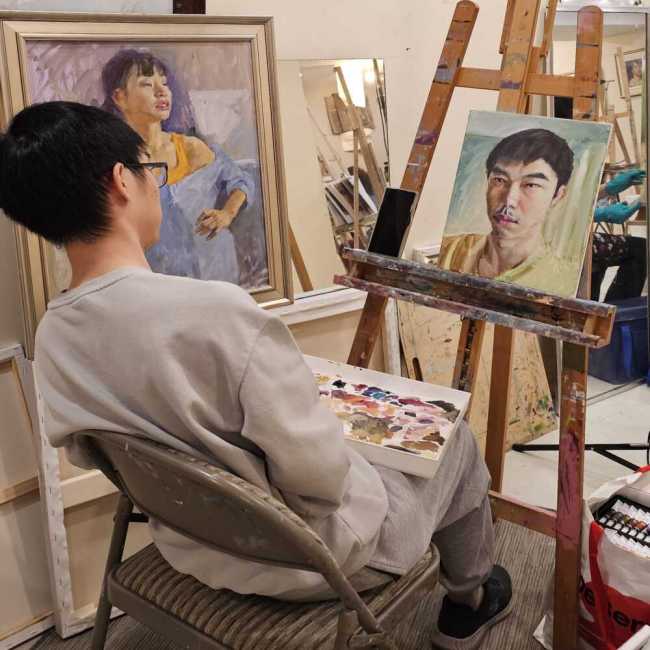
Over the course of an oil painting program, students will learn a lot about colors, including mixing, temperature, glazing, and more. However, not many classes teach their students about paint consistency.
As one of the most comprehensive and holistic art schools in Toronto, at VR School of Art, we encourage our students to understand how paint feels and moves on the brush. The paint’s consistency can actually influence how it behaves on the canvas, too, leading to the creation of different and interesting visual effects.
If you are an art student, this blog will help you understand that paint consistency is not a fixed concept, not even within the same painting. Let’s begin.
Paint consistency refers to the thinness or thickness of the paint used, and it largely determines its fluidity and handling quality. Certain sections of any artwork are likely to feature a thick coat of paint with visible brushstrokes, while other sections may be thinned out to create lightness, transparency, and smoother transitions.
In our oil painting classes, we encourage students to experiment with both consistencies. This helps them create sharper focal areas along with more natural backgrounds, thus lending their painting a more professional look.
The key is to choose the most appropriate paint consistency for that portion of the painting. Maintaining uniform consistency is likely to make the artwork look flatter and less visually engaging. However, smart variations can make it look alive. Here’s what we recommend during our oil painting lessons:
Use thick paint to create areas of stronger visual interest. It can also help in creating texture or in emphasizing focal areas. Thicker paint is also extremely useful in highlighting visually forward areas of the painting.
Work with more fluid or thin paint to create seamless and subtle color transitions. Thinner applications can also be used for block-ins or underpainting.
Remember that both thicker and thinner paint serve different purposes. Visible brushstrokes can add energy to a painting, while fluid applications can create a softer contrast.
At VR School of Art, North York’s top art school, we teach our students how to use paint consistency as a creative tool. Adjusting paint thickness and fluidity supports the creation of more textured, layered artwork that looks appealing and natural. Contact us to learn how our art classes can help you master various color concepts.
Not necessarily. Texture depends on both paint consistency and brush handling. To create more interesting textures, students must use both intentionally.
Yes. Passages with thicker paint take more time to dry than those with thinner paint.
Because different pigments have different handling qualities, this impacts how stiff or fluid they feel.