
Phone: (647) 894 7706
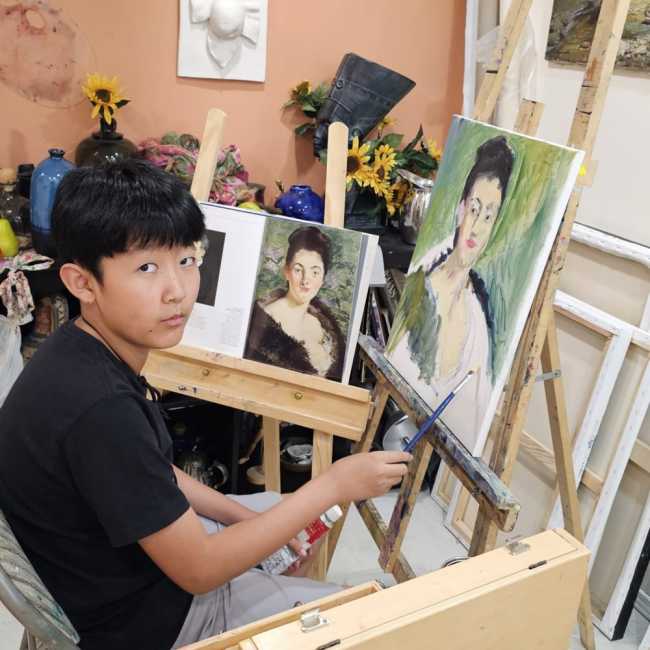
Many students find drawing shadows the most difficult part of portraiture. The truth is, capturing facial angles is much harder.
It’s not the exaggeration or omission of features that makes a painting look “off”. The usual culprit is facial angles gone wrong.
Students can improve their facial angle drawing skills with the help of structured lessons. At VR School of Art, Toronto’s top art school for portraiture painting, we train students how to see faces as a series of angles that are directionally related to each other.
Beginners often think that perfecting the eyes, noses, and mouths individually is key to drawing accurate faces.
However, painting classes in Toronto like ours know that focusing on isolated features is not the right approach. Rather, it is critical to observe the angles of each part of the face. How they tilt, align, and relate to each other plays a central role in creating accurate faces.
That is the approach we teach our students. We train them to notice how the angle of the mouth, or the tilt of the nose, or the slope of the jaw might change shape depending upon the pose the subject strikes.
We begin by teaching our students how to draw faces using straight lines. At this point, we encourage them to ignore curves for the time being and focus on direction and placement instead. This simple switch helps students recognize where a particular feature on the face is pointing. It could be upwards, downwards, or even angular.
We also ask our students to compare the angle of every individual feature on the face with the others. For example, knowing how an eyebrow arches in relation to the angle of the lips supports the painting of more accurate expressions.
Our art classes in Toronto treat facial angles as an integral part of portraiture lessons because even a small deviation in angles can negatively impact the likeness of the painting. Whether it is the tilt of the eye or the curve of the mouth, incorrect angles can make the final artwork look unnatural and caricaturish, even if the individual details have been correctly drawn.
A shift in perspective is all it takes for students to bridge the gap between being learners and budding artists. By understanding the importance of facial angles in portraiture painting, they can create more intentional and lifelike artwork. VR School of Art’s painting classes in Toronto help students master the basics of portraiture creation. Contact us to learn about our current drawing courses and their schedules.
No. They can also be used for drawing figures and still lifes in a more accurate manner.
Sketching over reference images is a good way for students to practice drawing facial angles outside of painting classes.
Yes. Even slight changes can completely alter the look of the face as compared to the reference.